
- Gravitational physics
-
Gravitational physics is the study of the gravitational force, particularly trying to develop theories that reconcile measured deviations from predictions made by the general theory of relativity.
We are interested in a range of primarily theoretical topics in gravitational physics. Physicists at Aberdeen pioneered methods of probing quantum gravity phenomenology using modern quantum atomic interferometry. We are interested in
- Quantum gravity
- Black holes
- Gravitational waves
- Modified gravity
- Experimental tests of classical and quantum gravity in the lab and in space
- Extended gravity with torsion
- Non-metricity
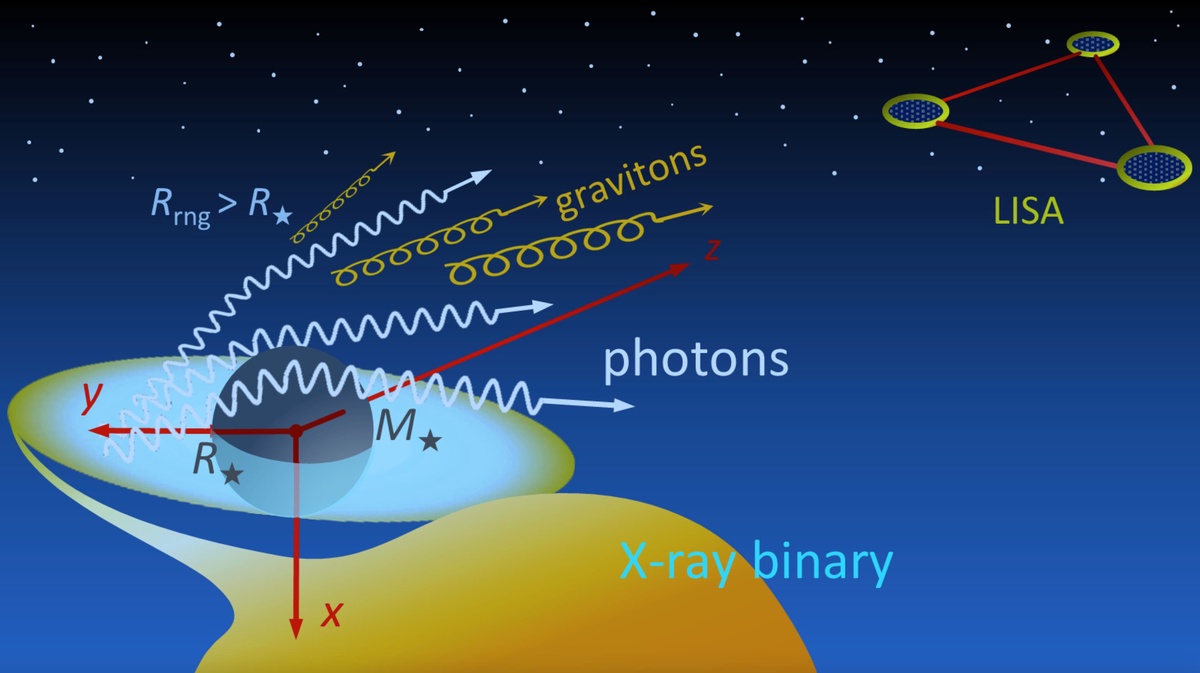
Right: Schematic of gravitational bremsstrahlung of light involving an X-ray binary. From Wang & Mieczkowska (2021).
Staff contact: Charles Wang.
- Planetary astrophysics
-
Planetary astrophysics is the study of planetary bodies, their interiors, atmospheres, and space environments, both inside and outside the Solar System. The main tools are in-situ and remote measurements from robotic spacecraft, observations made by ground-based telescopes, and a wide variety of numerical simulations.
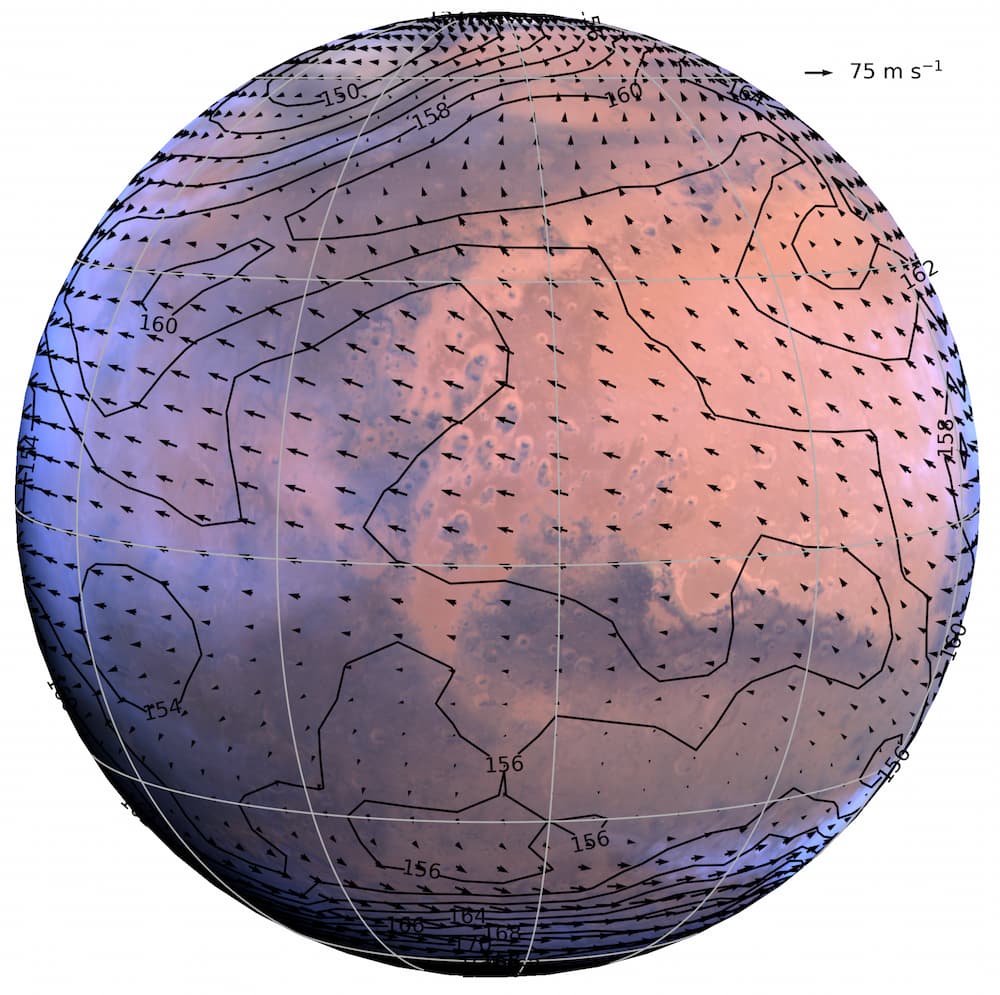
Our research in this area focuses on the atmospheric dynamics and climate of Mars and Jupiter. Planetary atmospheres are complex nonlinear systems whose observed behaviour can be understood and predicted using a hierarchy of numerical models. Our research uses planetary climate modelling, data assimilation, and ultraviolet, visible, and infrared spacecraft observations to study atmospheric motion and climate.
We currently play active roles in the ExoMars Trace Gas Orbiter and Emirates Mars Mission science teams.
Right: Mars atmosphere and surface during mid-2021, showing a reanalysis combining Emirates Mars Mission observations with a numerical simulation. Contours show temperature, and arrows show atmospheric motion (wind) at about 40 km altitude. From Young et al. (2022).
Staff contacts: Roland Young, Scott Doyle.
- Stellar astrophysics
-
Stellar astrophysics is the study of stars throughout their lifetimes, including their structure, formation, and evolution.
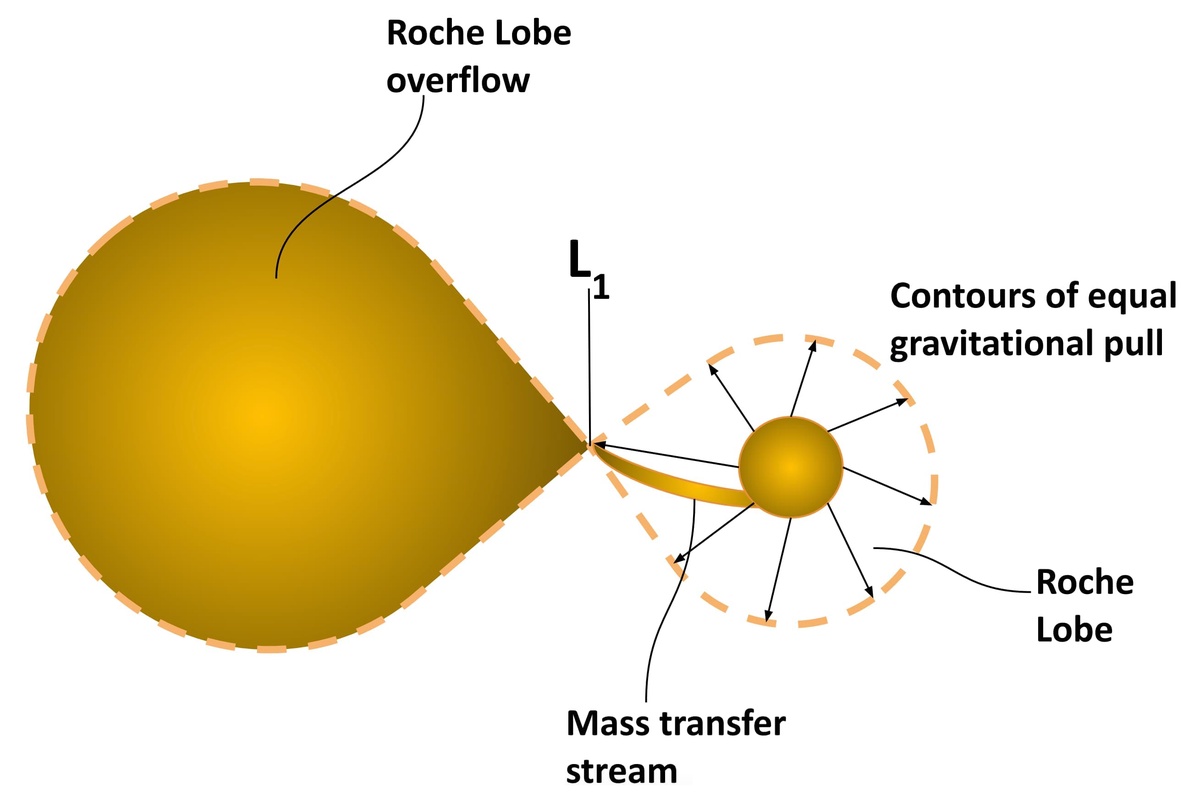
Right: Schematic of a semidetached binary star showing the Roche lobes, the inner Lagrangian point, and the mass transfer stream between the stars. From George et al. (2019).
Staff contacts: Sandip George, Murilo Baptista, Scott Doyle.
Academic staff
Header banner image: Observations and models of Mars (NASA/JPL/MGS/PIA02653, Young et al., 2022) and Jupiter (NASA/JPL/Cassini/PIA02873, Young et al., 2019).