
Our summary reports provide information on the progress and findings from some of our studies. You can find details on our latest reports here.
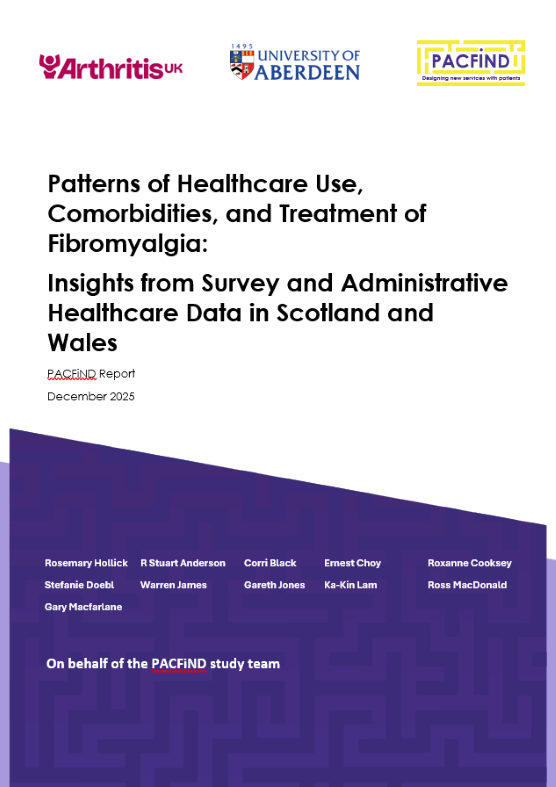
Patterns of Healthcare Use, Comorbidities, and Treatment of Fibromyalgia: Insights from Survey and Administrative Healthcare Data in Scotland and Wales
PACFiND Report
Technical Report Series (2025/003)
December 2025
The Patient-centred Care for Fibromyalgia: New pathway Design (PACFiND) project was led by the University of Aberdeen with partners across the UK and funded by Versus Arthritis (now Arthritis UK). Its goal was to understand the experiences of people living with fibromyalgia and design more effective, person-centred care pathways.
This report presents findings from a key area of the PACFiND project, which examined patterns of healthcare use, and clinical characteristics and treatments prescribed to people living with fibromyalgia across Scotland and Wales. Using survey and linked, administrative healthcare data, these analyses provide new insights into how people with fibromyalgia interact with the health system before and after diagnosis and highlight the implications of current care patterns for patient experience, safety, and service design.
Read the report here.
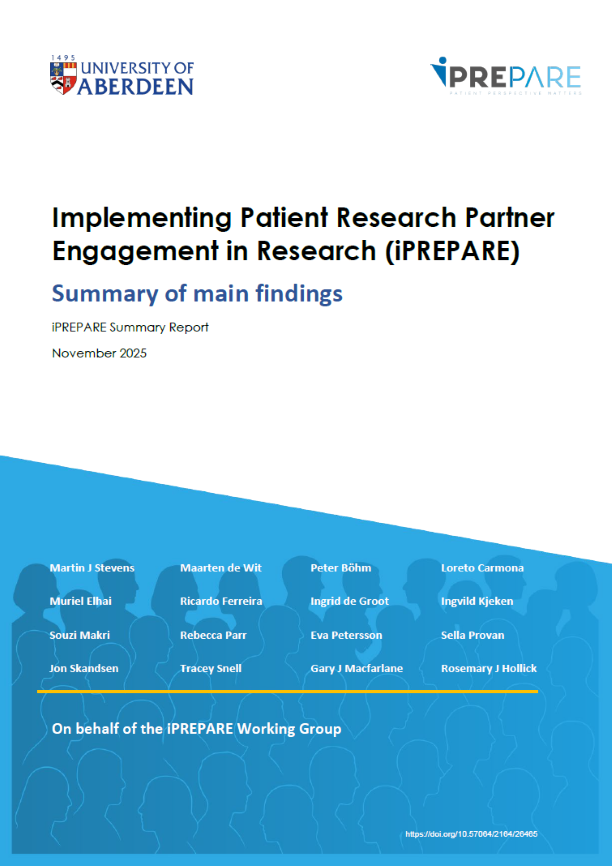
Implementing Patient Research Partner Engagement in Research (iPREPARE)
iPREPARE Summary Report
Technical Report Series (2025/002)
November 2025
https://doi.org/10.57064/2164/26465
Rheumatology has a strong history of collaboration with patient research partners (PRPs) to improve research outcomes. However, important gaps remain, particularly in the implementation of patient research partner (PRP) values and principles across the research spectrum. Engagement is often consultative and focused on more applied clinical and qualitative research, with significant power imbalances between researchers and PRPs. This study identified barriers to PRP involvement in Rheumatic and Musculoskeletal Disease (RMD) research, to prevent tokenism and to increase meaningful and sustainable relationships across the RMD research community.
We undertook a sequential, mixed methods study exploring the perceptions of the roles of PRPs amongst RMD researchers and PRPs. Stakeholders will be involved in all stages of study design and delivery. We co-designed a questionnaire to explore barriers to PRP participation from both PRP and researcher perspectives across the EULAR member community. The questionnaire explored implementation of PRP roles and power imbalances between PRPs and researchers. Semi-structured interviews with PRPs and RMD researchers explored findings from the questionnaire in greater detail. Interviews were thematically analysed to provide greater understanding and clarity around the issues raised.
This summarise the key findings of the study, including a description of PRP involvement in RMD research and how this varied across contexts (e.g., research settings, countries). It has identified barriers to participation and makes recommendations of what needs to change to ensure high-quality participation across studies in Europe.
Read the report here.
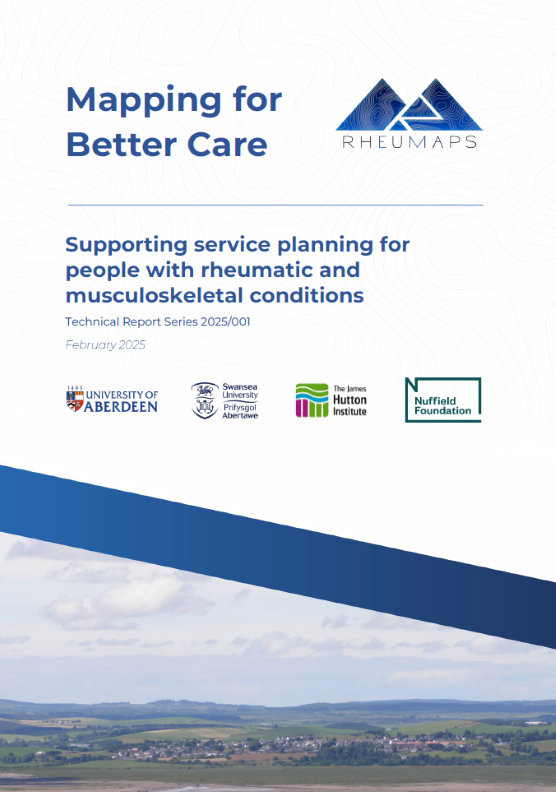
Mapping for Better Care: Supporting service planning for people with rheumatic and musculoskeletal conditions
Technical Report Series (2025/001)
February 2025
https://doi.org/10.57064/2164/25119
We are delighted to announce the publication of the final report from the RHEUMAPS study, which highlights key findings to support service planning at local, regional, and national levels for people living with rheumatic and musculoskeletal disorders (RMDs). The report focuses on four key areas:
- Exploring individual priorities for care
- Understanding people with RMDs
- Developing interactive geo-spatial tools to support service planning and evaluation
- Review of place-based health policies
The RHEUMAPS study provides important evidence and tools to support a policy shift towards a more integrated framework of care for people with RMDs. By supporting policymakers and healthcare providers in developing sustainable, equitable, and person-centred solutions, it contributes to the evolution of a learning healthcare system that meets the diverse and changing needs of those living with RMDs.
A copy of the executive summary of the report is available here.
You can download the full report by clicking on the image below:
Improving support to work resources for people living with rheumatic and musculoskeletal conditions
RHEUMAPS Work Support Resources Report
Technical Report Series (2024/002)
July 2024
https://doi.org/10.57064/2164/23927
Supporting people with health conditions to remain in work is a UK government priority. Rheumatic and musculoskeletal conditions greatly impact people's working lives, including conditions such as inflammatory arthritis (e.g., rheumatoid arthritis, psoriatic arthritis and axial spondyloarthritis), rare autoimmune conditions such as lupus and vasculitis, and other painful conditions such as osteoarthritis and fibromyalgia. They are one of the most common causes of days lost from work in the UK and people deciding to stop work earlier than intended.
Several resources and interventions are available to enable healthcare professionals to better support their patients to work well. In the UK numerous musculoskeletal charities websites and other online resources such as Healthtalk.org and the Pain Toolkit, provide work-related information and support for patients. However, people living with rheumatic and musculoskeletal conditions report that consultations with healthcare professionals are mainly focused on medical aspects of their condition and medications, and that work issues are rarely discussed. Support with work-related challenges often remains an unmet need for people with living with these conditions.
This report explores the awareness and use of work-related support services amongst people with rheumatic and musculoskeletal conditions and online work resources provided by UK musculoskeletal charities to identify specific areas for improvement.
Read the report here.
_-_July_2024.jpg)
Meeting the care priorities of people with rheumatic and musculoskeletal conditions: priorities for action
RHEUMAPS Care Priority Report
Technical Report Series (2024/001)
July 2024
https://doi.org/10.57064/2164/23928
Where people live can present a significant challenge to delivering timely and equitable healthcare. To effectively plan local and national services to meet the needs of people with rheumatic and musculoskeletal diseases (RMDs), we need to understand how many people have these conditions, who they are, where they live and how this relates to existing services. It is also important to understand people's care priorities, recognising that these might be different for different groups of patients, and what resources and services people feel are important, missing, or could be improved.
This report summarises the priorities for care of people living with a broad range of RMDS across the UK and the resources and services needed to meet these needs. It outlines a number of policy and practice recommendations to address the gaps identified.
Read the report here .
_-_July_2024.jpg)